

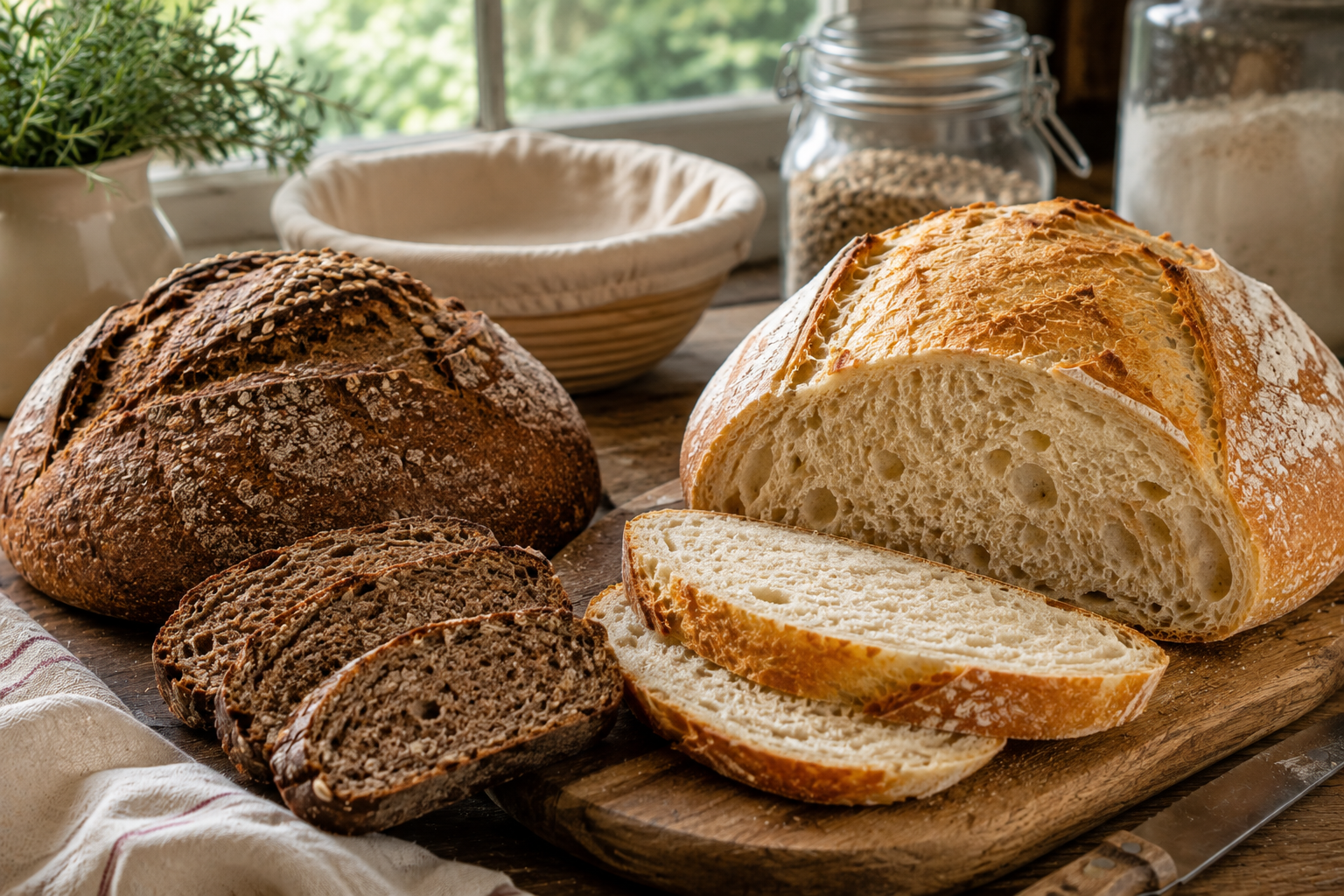
I used to think that removing gluten from the diet was the answer to just about everything—from too much abdominal fat to bloating and indigestion.
But more updated research—plus my own experience—has led me to another conclusion.
Maybe gluten isn’t the whole problem. And maybe we’ve been blaming the wrong thing.
Think about it. For centuries, bread was called the staff of life. Bread has been a staple food in civilizations around the world for thousands of years.
So why, all of a sudden, do so many people have trouble eating bread?
What happened?
Well, as it turns out, a lot has happened.
Bread Isn’t What It Used to Be
The grains have changed. The way we grow them has changed. The way we mill them has changed. And we’ve certainly changed the way we turn them into bread.
Modern wheat has been bred and selected for characteristics that make it particularly useful for modern agriculture and commercial baking. And today’s industrial bread bears little resemblance to the slowly fermented breads human beings ate for centuries.
Interestingly, research comparing ancient wheats such as Einkorn and Spelt with modern bread wheat shows that the story isn’t as simple as ancient wheat having “less gluten.” In fact, some ancient wheats contain more total gluten—but the types and structures of their gluten proteins can differ. That’s one more reason I don’t think we can reduce this entire discussion to one word: gluten.
Then there are modern agricultural chemicals, including glyphosate.
I’ve heard from countless people over the years who tell me essentially the same thing: “I can’t eat bread or pasta at home, but when I go to Italy, I can eat it every day and I feel fine.”
Perhaps you’ve experienced this yourself.
There may be many reasons for this. Different grains. Different growing practices. Different processing. Different fermentation. Different ingredients.
Agricultural practices also differ between the United States and Europe. For example, while glyphosate is still permitted in the European Union, the European Commission does not permit its use as a desiccant to control harvest timing or optimize threshing.
I don’t believe we can simply look at all of these foods, see that they contain gluten, and conclude that they’re identical.
They’re not.
And my own body has taught me that lesson beautifully.
I Eat Sourdough Bread All the Time
For the past year, I have been baking my own sourdough bread.
And I’ve had no problem with weight gain, bloating, or any of the other symptoms I’ve experienced with conventional bread or pasta.
I use a combination of Einkorn, Spelt, and Rye flour—organically grown and made into flour right here in Maine. I’ve been getting my grains from Maine Grains, which specializes in organic and heritage grains that are traditionally stone milled.
And I eat my bread regularly.
Sourdough fermentation actually changes the grain. The microorganisms in a sourdough starter begin breaking down components of the flour long before the bread ever reaches your digestive system.
A scientific review of sourdough fermentation and its potential health effects found that fermentation can modify or degrade a number of components in wheat and rye, including certain fermentable carbohydrates known as FODMAPs. Depending on the microorganisms and fermentation process used, substantial reductions in wheat fructans can occur.
That’s particularly interesting because some people who believe they are sensitive to gluten may actually be responding to something else in wheat.
In a randomized controlled crossover study of people with self-reported non-celiac gluten/wheat sensitivity, fructans produced more symptoms than gluten.
Think about the implications of that.
If you feel terrible after eating a slice of conventional bread, it doesn’t necessarily mean the gluten itself was responsible.
The way the bread was fermented may matter, too.
There is also research suggesting that sourdough fermentation can affect the body’s blood-sugar response. A systematic review of the nutritional benefits of sourdough examined studies looking at post-meal glucose and insulin responses to sourdough breads.
Does that mean every loaf of sourdough will have the same effect on everyone’s blood sugar? Of course not.
But I can tell you what happens in my body.
My homemade sourdough doesn’t affect me the way conventional bread does.
And that’s information I’m willing to listen to.
Your Body Is Always Giving You Information
This is something I’ve taught women for decades:
Your body knows.
We’re living in a culture that has become obsessed with telling us what we’re “allowed” to eat.
Fat is bad.
Then fat is good.
Eggs are bad.
Then eggs are good.
Carbs are bad.
Gluten is bad.
And suddenly an entire supermarket aisle is filled with products designed to save us from gluten.
Meanwhile, we’ve stopped asking one of the most important questions of all:
How does this food make me feel?
There is an enormous difference between eating an ultra-processed commercial product and eating a traditionally fermented food made from organically grown grains.
The ingredient may technically be called “wheat” in both cases.
But that doesn’t mean your body experiences them in the same way.
Gluten Free Doesn’t Mean Healthy
Here’s another thing I’ve come to realize.
A lot of gluten-free products may be worse for your body than the gluten you’re trying to avoid.
Look at the ingredients in some packaged gluten-free breads, crackers, cookies, muffins, and other products. Many rely heavily on refined starches and can be low in fiber, protein, and important nutrients.
In fact, the National Institute of Diabetes and Digestive and Kidney Diseases notes that some packaged gluten-free foods may be higher in fat and sugar than their gluten-containing counterparts and that unnecessarily eliminating gluten can reduce intake of nutrients such as fiber, iron, and calcium.
And here’s something else worth knowing.
A systematic review of gluten-free breads found that about 61 percent of the breads studied had a high glycemic index. Only about 18 percent were classified as low glycemic.
So that gluten-free bread you bought because you thought it was healthier may be sending your blood sugar soaring.
Then there’s rice.
Rice flour is commonly used in gluten-free foods, and rice tends to accumulate more arsenic than other crops. The FDA has studied inorganic arsenic in rice and rice-based products extensively and advises eating a variety of grains rather than relying heavily on rice.
Simply putting GLUTEN FREE on a package does not magically turn what’s inside into health food.
If you truly cannot tolerate gluten, that’s one thing.
But if you’re buying highly processed gluten-free foods because you believe they’re automatically healthier than traditionally prepared whole grains, I encourage you to take another look.
My Next Adventure: Milling My Own Grain
My next step is to purchase a grain mill so I can grind my own grains.
I’m very excited about this.
I have always believed that the closer a food is to its original state, the better it tends to be for the body.
There’s nothing like freshly milled flour. Whole-grain flour retains the bran and germ along with the endosperm, giving you the fiber, vitamins, minerals, healthy fats, and other naturally occurring compounds that are lost or reduced when grains are highly refined.
And there’s a wonderful movement happening right now to bring real grains and freshly milled flour back into our kitchens and communities.
Some schools are even doing it.
I was delighted to read about California schools experimenting with locally grown whole grains and milling flour for school meals.
Imagine that.
Instead of removing another food from children’s diets, we’re rediscovering how that food was traditionally grown, prepared, and eaten in the first place.
Now that’s a movement I can get behind.
“Man Cannot Live by Bread Alone”
My daughter and I joke about the old saying, “Man cannot live by bread alone.”
We look at each other and say:
“We do.”
Seriously, my sourdough has become a staple food in our home.
I make three or four loaves at a time and make sure I always have a couple in the freezer.
And I know what you’re going to ask me next:
“What’s your recipe?”
Here’s the problem.
I don’t have one.
At least not exactly.
I make it differently every time. I do it by feel.
Think: making sourdough biscuits while traveling west in a covered wagon.
Those women didn’t have digital gram scales.
When I first started making sourdough, I watched dozens of YouTube videos. People were weighing everything to the gram, measuring temperatures, calculating percentages, and keeping track of every minute.
It drove me nuts.
There’s absolutely nothing wrong with that approach.
It simply wasn’t right for me.
Those women who baked bread generations ago knew what dough was supposed to feel like. They learned through their hands, their eyes, their noses, and their experience.
That’s how I wanted to learn.
So that’s how I make my bread.
And I promise I’ll attempt to show you how I do it in a video because there’s nothing quite like my method on the Internet.
Gram scale not required.
So, Should You Give Up Gluten?
If you have celiac disease, yes. Gluten avoidance is medically necessary. The National Institute of Diabetes and Digestive and Kidney Diseases recommends a lifelong gluten-free diet for people with celiac disease because gluten triggers an immune reaction that damages the small intestine.
And some people clearly don’t tolerate gluten or wheat well. I’m not suggesting that you ignore what your body is telling you and start eating bread simply because I do.
I’m saying something quite different.
Don’t automatically assume that gluten is the villain.
Ask better questions.
What kind of grain am I eating?
How was it grown?
How was it milled?
How old is the flour?
What else has been added to it?
Was the bread allowed to ferment?
How processed is the finished food?
And most importantly:
How does my body respond when I eat it?
Years ago, I would have told many people to simply eliminate gluten.
Today, I’m much more interested in the quality of the grain, the way it’s grown, the way it’s prepared, and the wisdom of your own body.
I’ve rediscovered bread.
Real bread.
Organically grown grains. Traditional fermentation. Soon, freshly milled flour. Water. Salt. Time.
And my body is very happy with it.
Sometimes becoming healthier isn’t about eliminating another food.
Sometimes it’s about returning to the way that food was meant to be eaten.


I have adopted a version of healthy keto and intermittent fasting as way to support healing my body from the sad diet ☹️. I was trying to reverse chronic fatigue, digestive issues, and hormone imbalance. This particular way of eating combined with aerobic exercise (HIIT intervals) seemed to work some magic for me. I couldn’t believe the change in cognitive function especially as well as weight loss. I tried intermittent fasting to induce autophagy at the cellular level as I believe we have the ability to heal ourselves. Thank you so much for your informative article.
Kathy
I went gluten free last summer ‘17 when I was diagnosed with Lyme disease (you did not have that listed). What a difference it made in my life!! I also have fibromyalgia and Hashimoto’s Thyroiditis. I started to lose weight and from June ‘17 to Dec ‘17 I lost 23 lbs & I was not dieting, I was eating healthy! And my asthma also improved! I was coughing a lot when I was eating wheat crackers. My coughing slowed down a lot as I removed the wheat. One night I decided to eat the wheat crackers and I immediately began to start coughing that I had to use my asthma rescue inhaler to stop (I got pretty scared). I have never eaten wheat crackers again. My coughing is gone now, it took about 9 months.
I do have IBS and Diverticulitis, which also have become much better managed since I’m gluten free. And a year later, I have not gained any weight back. My Mind, Body, and Spirit feel so much healthier.
Thank you for your article. One thing I wonder about is your statement that some people who travel to Europe can eat wheat there but not at home. You make the correlation that it is the lack of preservatives that may be the culprit. I’ve talked to a couple who were surprised that the wife could eat wheat in Europe and wondered why. It turns out that the bakery they frequented still used an ‘old’ wheat as it used to be before it had been mutated for the purpose of creating taller, hardier stalks of wheat – which also happened to increase the gluten content. What is being grown as wheat in the US is nowhere near the same what that the pioneers ate long ago.
I agree with Ernalee and I have read numerous reports on how American wheat has been genetically modified. I’m surprised that you don’t believe that’s so. You have been my heroine for years with your Joy of life book and audio cd. By the way, I got “out if the boat”. Thank you.
Many people may not realize that there are actually a LOT of foods that can be problematic. My doctor put me on her “elimination diet” where I had to eliminate gluten, dairy, eggs, peanuts, pistachios, cashews, nightshade vegetables (potatoes, peppers, eggplant and tomatoes), shellfish, mackerel, GMOs, and non-grassfed beef. I was on this diet for six weeks. After the six weeks, I could have ONE of the above foods, then wait for 3-6 days to see if there was a reaction. Then I could add another, etc., etc., etc. I would NEVER have guessed the one problem food! It was nightshade vegetables. I was fine with all the other foods listed.
I am not aware of why glyphosate would be in store bought bread. This herbicide is not used in wheat production for weed control. I am an agronomist and have never once seen a farmer use this product in wheat production in 20 years.
From what I have been reading recently, glyphosate is now being promoted by its manufacturer, Monsanto, and used by growers as a desiccant on our crops just before harvest to dry them more quickly in preparation for harvest. This drying-out process happens slowly in the field if left to nature before crops can be harvested, but using glyphosate to kill the mature plants more quickly allows farmers to harvest sooner and clear the fields before the onset of late season bad weather. I’ve read a couple of other reasons it is being used late in the growing season on non-GMO crops, as well. Google it to learn more.
Basically, we are being poisoned with glyphosate in our food supply in ever-increasing ways and the only way to reduce it making its way into our bodies is to eat organic.
I love reading your articles Dr. Northrup. Thank you for sharing your expertise and spreading the ideas about what truly is ‘normal’ and healthy as we age and grow.
You mention in your article “there is no such thing as GMO wheat thank goodness” but that does not mean that wheat isn’t treated with conventional herbicides such as Roundup(TM) – also mentioned by a previous commenter, Sarah Dedman. Instructions that come with this product include treating your (non-GMO) conventional crops with it to both fight weeds and ensure a more uniform seed-head size. For this reason it would be great to include in your recommendations that those of us who chose to continue eating wheat check for ‘organic’ on the label as well. It doesn’t guarantee that there will be no herbicides (they can be carried on the wind from a conventional farm to a neighbouring organic farm), but it reduces the exposure as much as possible.
Thank you for providing the opportunity to submit comments.
This is a great article. I have been gluten freelance 1999. Recently I heard John Robins talk about Ezekiel Bread and how is is made from the wheat berries and not flour. It is also prepared with full fermentation time and baked slowly. He said that most of the commercial bread is made by quick rising and fast baking which contributes to the higher gluten content.
Anyway, after avoiding wheat for so long I decided to try the Ezekiel Bread 4:9 and I did fine – no reactions.
I only eat it once in awhile and enjoy it!!!
Therese
I think you might have some of that information incorrectly. From Wikipedia: “A wheat berry, or wheatberry, is a whole wheat kernel, composed of the bran, germ, and endosperm.” From Food for Life: “We start with whole, certified organically grown grains, beans and seeds, and sprout them in water. Then, we take the freshly sprouted live grains and slowly mash them, mix them into dough in small batches and slowly bake into bread.”
The term “flour” does not refer only to wheat but to any grain ground to a powder. Food for Life may not grind the grains into a fine powder, but they still mash them up. Many of the Ezekiel Bread products are NOT grain-free OR wheat-free. (Which is fine as far as I am concerned, I love Ezekiel Bread!)
The difference is that they use the whole wheat berry instead of just the endosperm, which requires the removal of the bran and the germ. From Food for Life: “. . . unique sprouting process activates enzymes, which naturally metabolize starch, carbohydrates and gluten protein. This may explain why so many gluten sensitive people may tolerate sprouted grains. We DO offer gluten free options, which will clearly state “Gluten Free” on the packaging.”
As I mentioned earlier, I love Ezekiel Bread. I find that if I have a digestive issue, such as loose stools, a couple of pieces of Ezekiel Bread actually fix that problem. I feel great when I eat Ezekiel Bread! (And no, I was not compensated in any way for this glowing recommendation. I just love the stuff!)
Dr Norhrup I question your statement to avoid citric acid. Yes it can be made fron wheat yet it is highly processed and purified. A process that fully removes any gluten proteins. Do you have the source you researched your information about citric acid as I would like to learn more. I have had celiac disease for over 10 years and if there is more up to date research on the subject I’d like to know.
Everybody should check out what the Medical Medium has to say about gluten and about everything. Gluten feeds pathogens and viruses which are the cause of most of the health problems we have nowadays, as well as eggs, dairy, etc. He has three wonderful books and you can find all of his podcasts at medical medium.com.
Hello Dr. Northrup
Thank you for sharing your expertise on women’s health. Many, including myself have benefitted.
I am concerned about your statement “one of the reasons so many people are now gluten intolerant has to do with the widespread use of GMO wheat”. Please be aware that to this date there actually is no commercially approved GMO wheat in the USA.
Looking forward to hearing from you on this.
Thank you!!!
It states in the article that currently no GMO wheat varieties. That supports your concern.
To Merlyn Rix: Your quoted statement does not appear in Dr. Northrup’s article. She states the same thing you did: that we do not have GMO wheat.
Hello Debra and Marilyn,
Yes, this IS confusing when you read it now!!
Originally, Dr. Northrup was asked the question, why is there increased incidence of gluten intolerance? She answered with the statement that, it was due to the widespread use of GMO wheat. Pretty impossible when to date there is no GMO wheat!! When I contacted her about my concern re: this misinformation, she appreciated receiving the correction, and said that she would change her blog immediately. She did. You are now reading what she wrote AFTER she made the revision, in response to my communication with her.
And that is why my comment as you read it above, doesn’t make sense. It was in response to her original message.
I am 60 and postmenopausal. I have been grain free for 2 years and I also practice intermittent fasting. By practicing those two things, I have never felt better in my life. I look 40, I sleep well, and I have boundless energy. I laugh at people who follow low calorie diets and eat six times a day. They drag their tail and make little progress toward their health goals.
Also my knees stopped hurting and my mind is sharp and focused. No more grains and constant eating!
Please share more details about your intermittent fasting.
Good on you!
I just turned 64 in human years and went gluten free in January 2016. It helped so many of my health issues, including depression, low energy, and craving for carbohydrates. I went grain-free a few months later and my energy improved again. My dental health is better, too, because the grains promote dental plaque. Congratulations, Cheryl Edwards, on your wonderful new health!
My husband and I went grain/ gluten free almost 2 years ago. We read Wheat belly and it makes all kind of sense as does your post. We stay away from the processed stuff, have dramatically cut our sugar…neither of us can lose a pound. He could lose 50+ and if I lost 10 I’d be thrilled although could lose more according to charts. I even exercise. The more I read the more I believe that the GMO wheat is terrible for us which is why I stay the course but why are we the only ones who can’t lose weight?
There is no GMO wheat. I am a farmer. I know this first hand. However, some, but not all, farmers spray their wheat pre-harvest with Roundup or its generic brand, to dry down their wheat. I do not. I think this should be outlawed.
An amazing experience ….listeninto you on the webinar! We are so fortunate to be able to benefit from your advice. Thx so much. I am 75 , eat mostly raw and slightly cooked vegetables and learned tonigh that gluten may be causing me neurotic hunger which is dissipating as I use Trinm Healthy Mama recipies. Also I do 2 hrs of stretching/core work and walking Every Day……. and use th Esmonde stretches additionally. Thus, I have on my own healed a baaaaad I T Band/ Trocanteric Bursitis that has plagued me for 2 years!
I have celiac disease and dermatitis herpetaformis. My oldest child is on a gluten-free diet because of behavior issues. She also is genetically predisposed. My youngest child is in a study at Mass General looking at genetics, microbiome, environment and metabolism as contributing factors in development of CD. I think it is interesting that when completing the dietary surveys I am not asked about GMOs or organic food consumption. There is a huge difference between a store bought gf muffin and a grain free, fruit sweetened muffin I make at home. My middle child will say “I’m gluten” and ask for bread. We are changing that for various reasons, adding the “chicken skin” you mention to our list. I want all my kids to be able to enjoy a healthy diet complete with gluten so they, hopefully, will avoid developing CD and its complications. I think gut health is the key. Fortunately, their pediatrician is holistically minded and is a very helpful resource!
I had been diagnosed with a wheat and milk allergy back in 2007. I went gluten-free and milk/yogurt free (I can eat hard cheeses). I developed stomach issues after a while…cramps, constipation or diarrhea. I ate tons of vegetables (soluble and insoluble fiber ones) and very little of the awful tasting gluten-free baked goods. I’m an alien and this planet’s medicine doesn’t work on me, btw. Last year I went back to eating both. Learned quickly that milk/yogurt is a NO! But, wheat is a YES! Since then I’ve had no stomach issues. I eat organic Non-GMO wheat products/flour and still eat tons of veggies. Some of us NEED wheat. Non-GMO wheat that is! We’re all different with different bodies.
Bianca– thank you SO much for this response. It’s going to help so many. Very insightful and fascinating.
Currently there is no GMO wheat on the market. It’s currently being tested by Monsanto, so that future is coming, but there is no GMO wheat currently for purchase in any way.
Thank you for bringing up the gluten free topic Dr. Northrup. I know you have recommended Dr. David Perlmutter’s books in other blogs. I read he New York Times best seller “Grain Brain”. What a wealth of information! He says that gluten is behind the epidemic of Alzheimer’s and dementia as well as so many other diseases. He also states what you have said many times Dr. Northrup…..that sugar is the cause of heart disease…..not fat. My husband and I quit sugar a few years ago along with soda pop. Since then we have quit dairy, wheat, soy, corn, barley, spelt and rye. His book outlines everything you should know to safeguard your overall health, especially your brain and gut which are totally related. To the degree your gut is healthy is to the degree your brain will be healthy. I just read something from Dr. Mike Dow that said that 17.1% of American adults DO NOT have brain fog which means that 82.9% of American adults have some form of brain fog. Since making our changes we no longer crave any of the stuff we gave up. We are both at our ideal weights without going “on a diet”.
This is just so inspiring!!! thank you!!
More symptoms I`ve gotten rid of since quitting gluten are scaly skin around the edges of my face, itchy breakouts on my scalp, cluster headaches, persistent sore throat, and ringing in my ears.
Bravo!! Love hearing that you’re doing so well.
Dr. Northrup, I been suffering from chronic migraines for the last 2.5 years. I wondering if gluten intolerance could cause my liver to become toxic I recently had a blood test my ALT was 65. Could my liver being so high could that cause me to have migraines everyday.
The liver is very much involved in migraines according to Traditional Chinese medicine. I would recommend a diet with lots of dark green leafy veggies. Also eliminate all processed foods. And perhaps– if you’re up to it, try the 28 day Cleanse in the book Medical Medium by Anthony William. It consists of raw fruits and veggies. That’s IT. And it really helps the liver.
I understand that our grains for the most part have been gmo’d . If I use organic spelt flour , am I safe from gmo. Or what flour is safe ? Can we trust anything?
I’d give organic flour a try and see what happens. It works very well for some. Not all. Notice the rest of the comments here.
To see what crops are GMO, we need only do a Google search. There are currently NO grains that are GMO:
Corn (field & sweet)
Soybeans
Cotton
Canola
Alfalfa
Sugar Beets (When you see a product that lists “sugar” in the ingredients, it is from GMO sugar beets. Best to eat Pure Cane Sugar instead)
Papaya
Squash
Arctic Apple
Innate Potato
Aquabounty Salmon
Arctic apples, Innate potatoes and Aquabounty Salmon have all been approved but are not yet available to consumers.
Sorry, forgot that Corn is considered a grain…
My husband and I have been primarily gluten free since last July and I cannot believe how much better we feel. I still have the odd bit but he is pretty strict. Weight control is no longer an issue and no bloating pain either. Love the feeling of gluten free.
I was wondering if you could provide us with a good gluten free food link? Also so recipes would be nice, such as homemade ketchup and gravies and other maybe some sweet treats! Thank you for all your information and hard work.
http://www.amysglutenfreepantry.com is my website 🙂 Elana’s pantry is a great recipe/lifestyle resource as well.
Arrowroot is a great thickener for gravies. You can make a roux with butter and arrowroot and add it to chicken stock for a lovely gravy along with fresh herbs. Good luck!
Nice!! thank you Amy!
As a post-menopausal women at 54, I thought the weight gain and increasing number of health issues were part of aging.
I had had my thyroid out 5 years before because of multi-nodular growths. I asked my Dr. if it could be diet related but was told emphatically “no”.
So when my eyes went blood red, I got a spreading blister-like rash, got terrible brain fog and memory decline, joint problems that felt like my bones were collapsing (Dr said impossible), I finally had enough. Started researching on line and went completely gluten free. First 3 weeks were hard as my husband continued to eat donuts, pie etc in front of me. However after those first few weeks I was no longer hungry 1 hr after dinner and I no longer had an insatiable appetite for gluten. My symptoms started clearing up after 2 weeks and over the next year I lost 35 lbs effortlessly. Did not start exercising (know I should) and did NOT eat the gluten free products at all. Having a hamburger at A&W or McDonalds, ask for lettuce around it instead of the bun. I’ve done the same for breakfast sandwiches and never have a problem.
I have now also eliminated Corn, Soy, Canola and non-organic sugar (sugarbeets)
as much as I can.
Exploding & uncontrollable Diarrhea – GONE.
Try it. You will feel amazing as your body goes back to it’s natural set point.
This is absolutely fantastic to hear. I applaud you!! yep– now you know. That weight gain and bloating has NOTHING to do with aging.
Thank you Catherine for this inspiration. Just like you I am 56 now and though I just became menopausal a month ago and gluten free in 2007 I have still had joint problems, stomach issues, eye problems(dry and sometimes capillaries break in them), fatigue and migraines.When I first went gluten free I lost 25 lbs effortlessly but then I discovered the gluten free products and the weight is all back. Wondering if what Dr. Northrup said could be the problem- the toxins in the gluten free products. My triglycerides are horrible since starting this diet! Am also on Vitamin D supplements but can’t seem to get my levels beyond 20. My thyroid, liver and fasting glucose tests are normal.
Overall, a great article. The FDA has not approved GMO wheat, but they might as well have. The GMO products are corn and soy, mainly, and the list is growing. The problem GMOs (not all are evil) work to make a plant immune to poisons made by Monsanto and some other chemical companies. That enables farmers to spray to kill weeds while the corn and soy do not die. However, the chemicals, especially Round-Up, remain in the plants and are passed on to us in our food. It may be in small amounts, but, as I understand it, the effect is cumulative and the chemicals take much longer to leave the body that it does for us to consume them. The deal with wheat is that Round-Up, the poisonous herbicide, is sprayed on wheat to kill it just prior to harvest. The wheat is easier to harvest and the crop is, for some reason, more consistent over large areas of farmland — all ripe at the same time, somehow — than if the wheat had been allowed to ripen, naturally, on the stalks. GMO crops are being planted less because the promised gains in harvest are not being achieved. This partly due to the fact that Round-Up kills the soil bacteria — the soil microbiome — that is crucial in the life of healthy plants. Monsanto’s Round-Up have been a double disaster. Growing public awareness and its failure to deliver on promises made by Monsanto are likely to greatly reduce its use, sooner or later, in the future.
Thank you for this addition to the article. I appreciate it.
Wow! I’ve been off all grains for 2 1/2 weeks now, and I just felt the back of my arms and the bumps are gone! I didn’t know there was a correlation to gluten. Thanks for that little fact! My arms are smooooth…. 🙂
Did u emiliminate dressings also ? Or just the breads , pastas , grains , etc ? I haven’t eliminated the dressings and sauces . I have those annoying bumps on my arm and would love to see them go away 😉 …
Dr. Northrup, your blog came at a great time in my life. I have just finished reading two books (Grain Brain and Wheat Belly), and am convinced that it would be a good idea to try going gluten-free, if just to see how it makes me feel.
Last summer my blood sugar was so high I was facing medication because of it, in addition to the medication I was already taking to lower my cholesterol. I thought, “What next?” and realized I was at a crossroads in my life.
My first thought was to begin exercising every day, which I have been able to do because I put a stationary bike in my living room. I can either watch TV or read while I cycle for half an hour. After I lost 15 pounds, both my cholesterol and blood sugar levels dropped to normal levels, and I finally was able to get off the statins I had been on for 15 years.
I felt so good, I was motivated to look at my diet more carefully, and deliberately choose what foods and drinks I wanted in my new, healthy life, and what foods I was ready to say good-bye to. Now I’ve lost another 5 pounds, and my only problem is trying not to lose weight too quickly. At 75, my skin probably isn’t going to bounce back quickly!
Thanks for being an inspiration to me and millions of other women!
This is just fantastic. And thank you for being proof that age has very little to do with one’s state of health. It’s lifestyle.
Gluten sensitivity arises when glutinous grains are not prepared properly. It is difficult for EVERYONE to digest gluten because our modern methods of preparation do not allow time for the gluten to break down before consumption. Proper methods of preparation include: soaking glutinous grains/flour in yogurt, vinegar, or lemon juice; purchasing flour made from sprouted grains or sprouting them yourself; and making/ eating bread prepared with a sour dough starter instead of yeast. Yes go gluten free if you are celiac or if one of the above methods of preparation aren’t available. Otherwise I don’t believe there is a need for everyone to renounce glutinous grains.
What a wealth of information! Thank you! I have been grain-free for 8 months now, and I have never felt better :-))
I have been gluten free for 5 years and have never looked back. I healed hashimoto’s, adrenal fatigue, lost weight, gained energy, sleep like a baby and feel terrific. I have run two 1/2 marathons since then and have a very active lifestyle not to mention that I no longer have brain fog or joint pain. It was the best decision I ever made. Not too long ago I eliminated all grains from my diet and feel great! My mantra is Eat Real Food!
wow, thanks for sharing. I feel hopeful. I was diagnosed with hashimoto’s and was never told of the corrolation of this disease and gluten. You have inspired me to try to cure myself with eating Real Food.
Thank you,
My partner was diagnosed with celiac dis ease about 7 years ago. We both eat gluten free. Except for a raisin bran muffin for me a few times a week.
I notice that my digestive system works much better. Also, NO soy for me! Highly toxic!!! It affects my nervous system. Took many years to conclude that.ON MY OWN.
Hello
Thank you for writing this blog. My youngest daughter, 11, has been diagnosed with celiac . I have preached for years about the harm of gluten and ironically it truly hit home. As a full time Family Studies high school teacher and registered Holistic Nutritionist I am so involved in helping my daughter and other 3 children, whom are fully on board. Unfortunately, my celiac girl is still having symptoms of celiac even though we gave been rigid and I’m happy to read in your blog it could take years.
I have read several books, talked and interviewed several Drs and make gluten free, lactose free, corn free, grain free meals to build a strong system for her and to help avoid any future autoimmune diseaeses
I am try to write a book and I hope that one day Dr Northrup you will one day have it in your hands
Blessings
I went gluten-free almost 2 years ago. Amazing difference in my IBS. Major lifestyle change for the better
Absolutely love your work! Yes I was diagnosed with Celiac last August. I am 56 and probably have suffered all my life mostly symptom free of what are classic signs. As I began to read your books on menopause because I was experiencing hormone imbalance-hot flashes mainly, weight gain and sleeplessness I began my journey back to health and was diagnosed with celiac.
My father died at the age of 59 of cancer he had been on medications most his life for bi-polar disease. I too was going down that same path. I had been on anti-depressants for 20 years. I began working with integrative medical professionals and an alternative medicine. I am a trained medical technologist though I have been working in the plant biology field for 35 years I understand alot about the body and how it functions. I had my SNP testing down to get the genetic picture and I was concerned because I have one of the MTHFR mutations. A1298C. Anyway long story short my integrative medical Dr. did follow up blood work and testing based on my SNP profile and the only thing that showed up was the Celiac disease. My husband was pretty skeptical but I totally cut it out of our diets and we both feel amazing. Eating whole foods and mostly following the Paleo diet. You don’t know how bad you feel till you start to feel better. I was plagued by arthritis getting countless steroid injections and we both thought that the fat(middle age spread) and the aches and pains were just due to old age along with the failing organs,surgeries and increase in medications-down the road our parents were going and then cancer and death! No! I read Goddess’s never Age and I was determined you are right! I am not going down that path!! I feel amazing at the age of 55 better than ever!! Changing my diet, exercising(Classical Stretch everyday with Miranda Esmond White), better sleep, decreasing stress levels with mindfulness and meditation, it’s all working. I have followed countless summits on the web “The Gut Summit”, “The Metabolism Summit”, “The Fat Summit” and the Truth about Cancer. WOW I totally believe we have been mislead and bless you and thanks to all of the people bringing this to our attention!! I love You !!!
Sincerely Robin W.
I always LOVE hearing about someone like you who “gets it” that we’ve been sold a bill of goods in our culture about expecting to deteriorate with increasing chronologic age. It is just a myth as you have to beautifully discovered. Thank you.
Chris,
Thanks for this informative blog.
Carol Bass wants to get in touch with you. She lives on Edisto Island, near Charleston and wants you to come speak at The Sophia Institute. Her email address is carolrbass@gmail.com
Blessings to you, Gail Cinelli
I am also reading Dr. Hyman’s newsletter and he is writing that unmodified potato starch is a healthy way to help clean up the gut. I have been using it for about two weeks now and my constipation is a lot better. Can you address this? I take a a tablespoon with a glass of water every morning.
I read the same newsletter and ordered some. Makes all kinds of sense. I’m right there with you!
I have been gluten-free for years but still need to take Armour thyroid. Will I ever be able to discontinue it?
You might– depends on also eliminated chlorine and flouride from the water you drink. And making sure you’re getting enough iodine. Check out the books by David Brownstein
I am proof that going gluten free changes a person’s life. I went gluten free and lost 137 lbs. I have kept it off for 4 years.
We recently went 100% gluten free because my 13 year-old was diagnosed with celiac. Though I’ve avoided wheat off and on for years, this takes it to an entirely different level.
Though I wouldn’t be surprised if you told me that GMO wheat *has* actually infiltrated our food supply, I believe at this point it is banned and would be sort of a rogue presence rather than the norm.
I personally lay the blame on the excessive amount of gluten we’ve hybridized for, the way it’s an additive everywhere you look, and most importantly the way that farmers prepare wheat crops for harvest by literally *dousing* them with glyphosate, aka “Round-Up”.
You’ve got it!
thank you for your guidance. I would like to know how to cure Hashimoto and leaky gut.
To learn more about Hashimoto’s, check out Dr. Izabella Wentz who has an excellent website. She went through her own journey with H.
Hi Nieves,
There are some great resources with Ali Miller, RD. Check out this blog article relating to Hashimotos – https://www.alimillerrd.com/treatments/autoimmune-diseases/
She has a webinar coming up on May 4th about leaky gut/gut restoration – https://www.alimillerrd.com/shop/all/webinar-test-product-2/
Good luck to you!
J
Thanks Jodie! it takes a village.